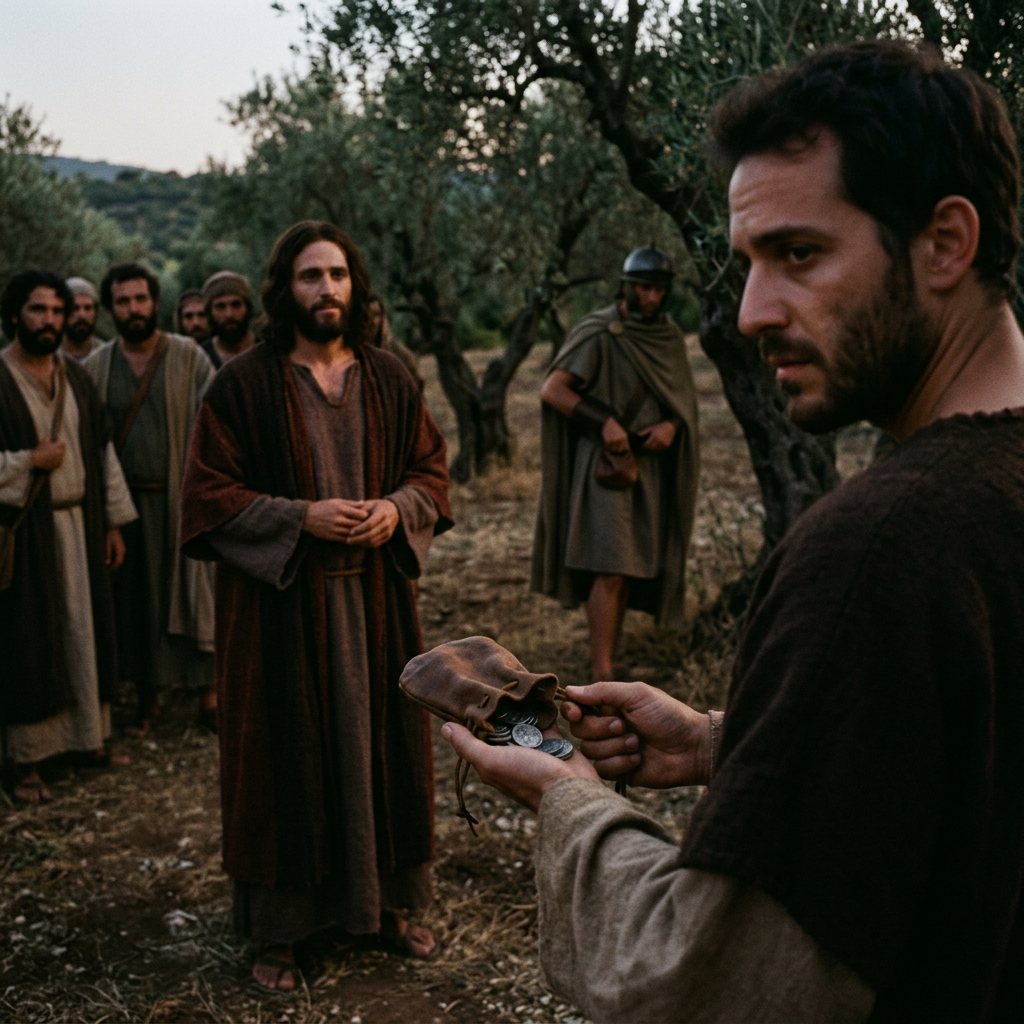
One of the most detailed fulfilled prophecies of Jesus did not happen centuries after he spoke it.
It happened the same night.
At the dinner table.
In front of witnesses.
With a name attached.
The Scene
It was the night before the crucifixion.
Jesus was at the Last Supper with his twelve disciples.
He had washed their feet.
He had broken bread with them.
These were his closest friends.
Men who had walked with him for three years.
Then the mood shifted.
After he had said this, Jesus was troubled in spirit and testified, “Very truly I tell you, one of you is going to betray me.” John 13:21 (NIV)
His disciples stared at one another, at a loss to know which of them he meant. John 13:22 (NIV)
Nobody suspected Judas.
He had been with them from the beginning. He managed the group’s finances.
He was trusted enough to hold the money bag.
So the disciple closest to Jesus leaned over and asked him directly: Lord, who is it?
Jesus answered with a sign so subtle that most people at the table still did not understand it.
“It is the one to whom I will give this piece of bread when I have dipped it in the dish.”
Then, dipping the piece of bread, he gave it to Judas, the son of Simon Iscariot. John 13:26 (NIV)
As soon as Judas took the bread, Satan entered into him. So Jesus told him, “What you are about to do, do quickly.” John 13:27 (NIV)
But no one at the meal understood why Jesus said this to him. Since Judas had charge of the money, some thought Jesus was telling him to buy what was needed for the festival, or to give something to the poor. John 13:28-29 (NIV)
Judas left into the night.
And before morning, Judas had handed Jesus over to the chief priests for thirty pieces of silver.
This Was Not a Guess
A skeptic might say Jesus sensed tension in Judas and made an educated guess.
But the details surrounding the betrayal go far deeper than one dinner table moment.
Five hundred years before Jesus was born, the prophet Zechariah wrote this:
“So they paid me thirty pieces of silver. And the Lord said to me, ‘Throw it to the potter’ — the handsome price at which they valued me!” Zechariah 11:12-13 (NIV)
That is thirty pieces of silver. Thrown into the Temple. Used for a potter’s field.
Matthew 27:3-5 records Judas throwing the thirty pieces of silver into the Temple in remorse before going out and hanging himself.
Matthew 27:6-7 records the chief priests using that same money to buy a potter’s field because they could not put blood money back into the treasury.
Every detail Zechariah wrote five centuries earlier matched exactly.
The specific amount. The act of throwing it into the Temple. The potter’s field.
This is one of the most precisely documented fulfilled prophecies of Jesus in the entire Bible.
What His Enemies Confirmed
Here is what makes this impossible to dismiss.
Judas went to the chief priests voluntarily. They did not recruit him. He approached them. Matthew 26:14-15.
The chief priests paid him. They set the price. They chose thirty pieces of silver.
None of them were reading Zechariah when they did it.
They were simply doing what they wanted to do.
And in doing so they fulfilled a prophecy written five hundred years earlier down to the exact amount of money.
Why This Matters
Jesus did not just predict a betrayal.
He named it at a dinner table.
He identified the person with a specific gesture.
He told him to go and do it quickly.
And the price paid for that betrayal had already been written in Scripture centuries before either of them was born.
That is not a coincidence.
That is the kind of track record that gives us good reason to trust what Jesus said.
Including the promise that He is coming back.

If you’re wondering whether Jesus really was who He claimed to be, that’s the question this entire website explores.
Start at the beginning with, Did Jesus Lie?
More Questions About Jesus
Did Jesus come for everyone or just the Jews?
Jesus’ earthly ministry began with Israel because He came to fulfill God’s promises to His chosen people. But from the beginning, God’s plan was to extend salvation to every nation through Him. After His resurrection, Jesus commanded His followers to take the gospel to all nations, opening the invitation to everyone who believes. Learn more in Did Jesus Come for Everyone or Just the Jews?
Did Jesus ever back down from His claims?
No. Even when His words led to arrest, beatings, mockery, and ultimately crucifixion, Jesus never withdrew His claims about who He was. Instead of denying the truth to save His life, He stood by everything He had said. Read more in Did Jesus Ever Back Down?
Did Jesus promise He is coming back?
Yes. On the night before His crucifixion, Jesus promised His disciples that He was going to prepare a place for us. Because every fulfilled prophecy and prediction strengthened His credibility, many Christians trust that this promise will also be fulfilled. Learn more in Did Jesus Promise He Is Coming Back?
Why didn’t the other disciples suspect Judas?
The Gospels show that Judas had earned the trust of the other disciples. He handled the group’s money and had traveled with Jesus from the beginning. Even after Jesus identified His betrayer by giving Judas a piece of bread, the others assumed Judas was leaving to buy supplies or give money to the poor.
Why were thirty pieces of silver significant?
Thirty pieces of silver was not a random amount. The prophet Zechariah recorded that exact price more than 500 years before Jesus was born, along with details about the money being thrown into the Temple and ultimately used to purchase a potter’s field. The events surrounding Judas’ betrayal fulfilled those details with remarkable precision.
Could Judas have chosen not to betray Jesus?
The Bible teaches that Judas acted willingly and was responsible for his own decisions, even though his actions fulfilled prophecy. Jesus’ foreknowledge did not force Judas to betray Him; rather, it demonstrated that God already knew what Judas would freely choose.
Why does this website ask, “Did Jesus Lie?”
Every article on this website explores a different claim, prophecy, promise, or prediction made by Jesus. Together they answer one central question: Was Jesus telling the truth? If you’re beginning your journey, start with Did Jesus Lie? to see how all of the evidence connects.
Leave a Reply