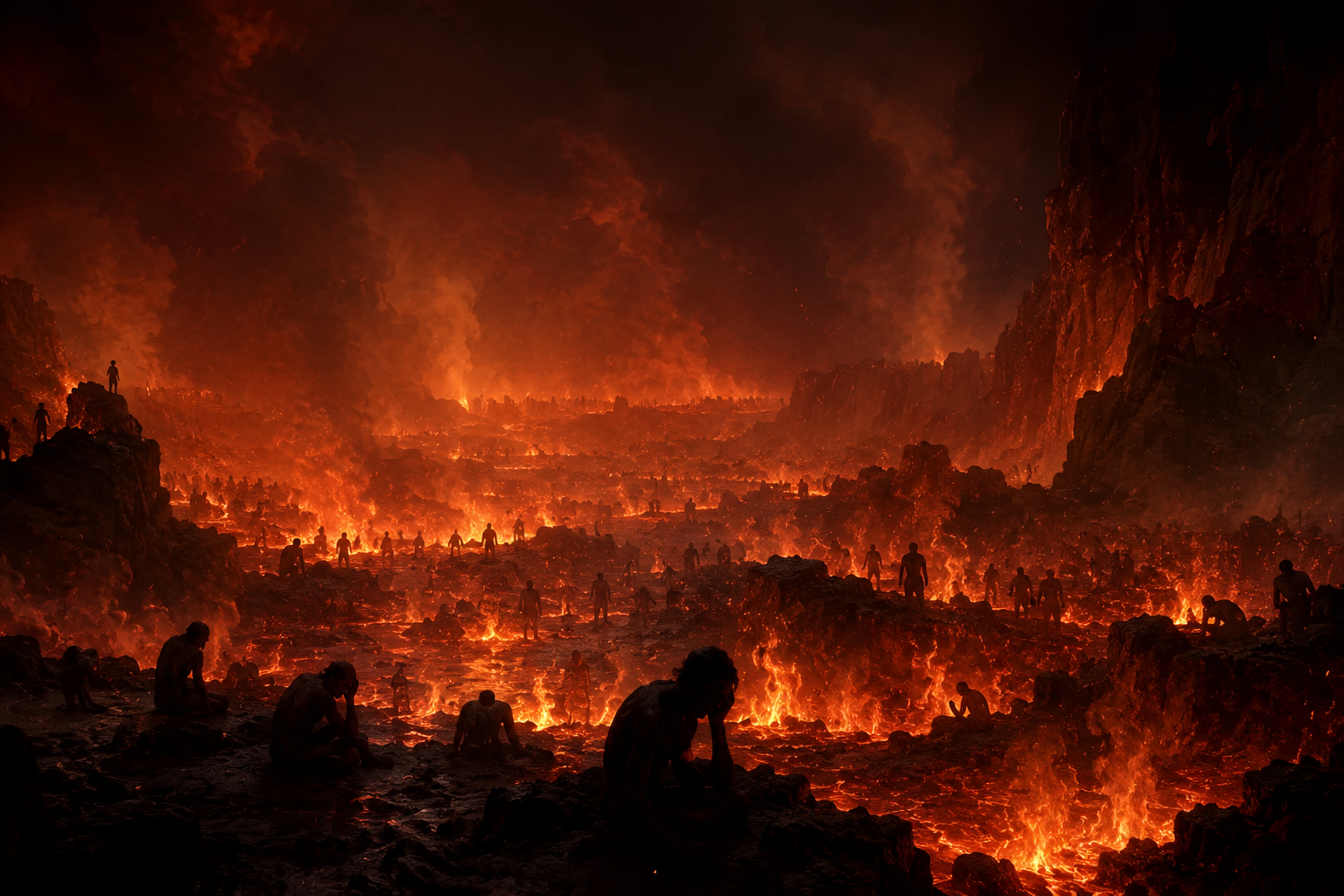
Countless people have an idea of hell shaped by movies, cartoons, or offhand jokes.
Red skin. Pitchforks. A place reserved only for “really bad” people.
But what did Jesus Himself say about it?
The answer might surprise you.
Jesus spoke about hell more than almost any other subject in the Gospels, more than He spoke about heaven.
He did not treat it as a metaphor or a scare tactic. He described it in specific, repeated terms.
Here is what Scripture says, and where it says it.
Hell Starts With a Choice
The Bible frames the afterlife as a fork in the road. Judgment follows death, and judgment leads to one of two destinations.
Hebrews 9:27 puts it plainly. “Just as people are destined to die once, and after that to face judgment.”
Jesus described this fork in Matthew 25:46. “Then they will go away to eternal punishment, but the righteous to eternal life.”
Two paths. Both described as eternal. Not one eternal and one temporary.
Sheol and Hades: The Place of the Dead
In the Old Testament, the dead were described as going to Sheol, a Hebrew word referring to the realm of the dead in general. It applied to both the righteous and the wicked. Even then, there was an understanding that death was not the end of a person’s existence.
Daniel 12:2 says some will rise “to everlasting life” and others “to shame and everlasting contempt.”
By the New Testament, Jesus used the Greek word Hades for this same place, and He gave us one of the clearest pictures of it in the story of the rich man and Lazarus in Luke 16:19 to 31.
The rich man dies and finds himself in torment. Lazarus, a poor believer, is carried to Abraham’s side. Between them sits what the passage calls a great chasm, fixed so that no one can cross from one side to the other.
The rich man begs for a single drop of water on his tongue.
He is refused.
He then begs that someone warn his five living brothers so they do not end up in the same place.
Gehenna: The Word Jesus Used Most
Jesus also used a second term, Gehenna, which is where the English word “hell” often comes from in translations of His teaching.
Gehenna was tied to a real location outside Jerusalem, the Valley of Hinnom, a place with a dark history involving fire and, according to 2 Kings 23:10, child sacrifice in Israel’s past.
Jesus took that image, one His listeners already associated with judgment and destruction, and used it to describe final punishment.
In Mark 9:43, He said it would be better to enter life maimed than to keep both hands and go into Gehenna, “where the fire never goes out.”
What the Bible Says Hell Is Actually Like
Pulling together what Jesus and the rest of Scripture teach, several details repeat consistently.
It is eternal, not temporary. Matthew 25:46 and Revelation 14:11 both use lasting, ongoing language, not language describing a phase or a sentence with an end date.
It involves conscious suffering. Luke 16:23 to 24 describes the rich man as being “in torment” and in “agony in this fire.” Matthew 13:42 describes “weeping and gnashing of teeth.”
It involves fire. Mark 9:43 calls it unquenchable fire. Revelation 20:14 to 15 describes “the lake of fire.” Revelation 14:10 adds “fire and sulfur.”
It is darkness, not light. Matthew 8:12 calls it “outer darkness.” Since Scripture describes God as light, complete separation from Him is described in terms of complete darkness.
There is no relief and no end. Mark 9:48 quotes imagery of a fire that is never quenched. Revelation 14:11 says “there is no rest day or night.”
It includes deep regret. In Luke 16:24, the rich man’s first instinct is desperate pleading, not defiance.
It is described as thirst without answer. The rich man’s specific request, just a drop of water, is denied.
It is total separation from everything good. 2 Thessalonians 1:9 describes it as being shut out from the Lord’s presence. Since Scripture ties all goodness, peace, and joy back to God, separation from Him means separation from all of it.
It is called the second death. Revelation 20:14 uses this term for final, eternal separation from the source of life, distinct from ordinary physical death.
Satan and his angels are there too. Matthew 25:41 describes hell as originally prepared for the devil and his angels, with unbelievers joining them by their own rejection of God.
Judgment appears to be measured, not identical for everyone. Matthew 11:22 to 24 suggests that some will face greater judgment than others, and Revelation 20:12 describes books being opened and the dead being “judged according to what they had done.” This lines up with Ecclesiastes 12:14, which says God will bring every deed into judgment, “including every hidden thing.”
Not Purgatory
It is worth noting what the Bible does not describe. Purgatory, a place where sins are supposedly cleansed after death before a person can enter heaven, does not appear anywhere in Scripture.
It was a later doctrine, not a biblical one.
The Bible instead teaches that Christ’s death on the cross fully paid for sin.
Nothing needs to be added to that. To claim otherwise is, in effect, to claim His sacrifice was not enough.
Why Jesus Talked About This So Much
It would be easy to read all of this and think Jesus was simply trying to frighten people. But look at how He framed it. In Mark 9:43, His warning about hell comes right alongside an appeal, urging people toward life, not away from Him.
The purpose was never to terrify people into compliance. It was to make the stakes clear.
Scripture describes this life as short, even temporary, “like a mist,” as James 4:14 puts it. What comes after is not.
The rich man in Luke 16, once in torment, wanted only one thing: for someone to warn the people he loved before it was too late for them too.
The Choice Still Stands
Scripture is consistent that God does not force anyone into either destination.
2 Corinthians 4:18 draws the line between what is seen, which is temporary, and what is unseen, which is eternal.
The choice described throughout the Bible is not between good people and bad people.
It is between those who accept what Jesus did on the cross and those who do not.

If you’re wondering whether Jesus really was who He claimed to be, that’s the question this entire website explores.
Start at the beginning with, Did Jesus Lie?
More Questions About Jesus
What did Jesus say hell is like?
Jesus described hell using several serious images, including unquenchable fire, darkness, suffering, regret, and separation from God. He presented it as a real and eternal judgment rather than a temporary punishment. His warnings were intended to make the consequences of rejecting God clear.
Is hell eternal according to Jesus?
Yes. Jesus described eternal punishment alongside eternal life in Matthew 25:46. Both destinations are presented as lasting realities, not temporary conditions.
Did Jesus say everyone could be saved?
Jesus’ invitation was not limited to one race, nation, or ethnic group. He repeatedly described salvation as available to those who believe in Him, and His followers were commanded to take the gospel to every nation. Read more in Did Jesus Come for Everyone or Just the Jews?
Did Jesus predict His own resurrection?
Yes. Jesus repeatedly predicted that He would be killed and rise again. His resurrection is central to the Christian hope of eternal life because Jesus presented Himself as the resurrection and the life. Learn more in Did Jesus Predict His Resurrection?
Did Jesus promise He is coming back?
Yes. Jesus promised that He would return and gather His followers to Himself. Scripture also connects His return with the final defeat of evil and the establishment of His kingdom. Read more in Did Jesus Promise He Is Coming Back?
Did Jesus come to save people from their sins?
Yes. Jesus’ mission was directly connected to saving people from sin and bringing them into reconciliation with God. His death on the cross is presented in the New Testament as the sacrifice through which forgiveness and salvation are offered.
Did Jesus tell the truth about Isaiah 61?
Jesus read Isaiah 61 in the synagogue and declared that the Scripture was being fulfilled through Him. His mission included proclaiming good news, freedom, and God’s favor. Learn more in Did Jesus Tell the Truth About Isaiah 61?
What happens to people who believe in Jesus?
Jesus promised eternal life to those who believe in Him. The Holy Spirit is also given to believers as the Helper who remains with them. Learn more in Did Jesus Promise the Holy Spirit Would Come?
Why does this website ask, “Did Jesus Lie?”
Every article on this website examines a different claim, prophecy, promise, or prediction made by Jesus. Together they answer one central question: Was Jesus telling the truth? If you’re beginning your journey, start with Did Jesus Lie? to see how all of the evidence fits together.
Leave a Reply