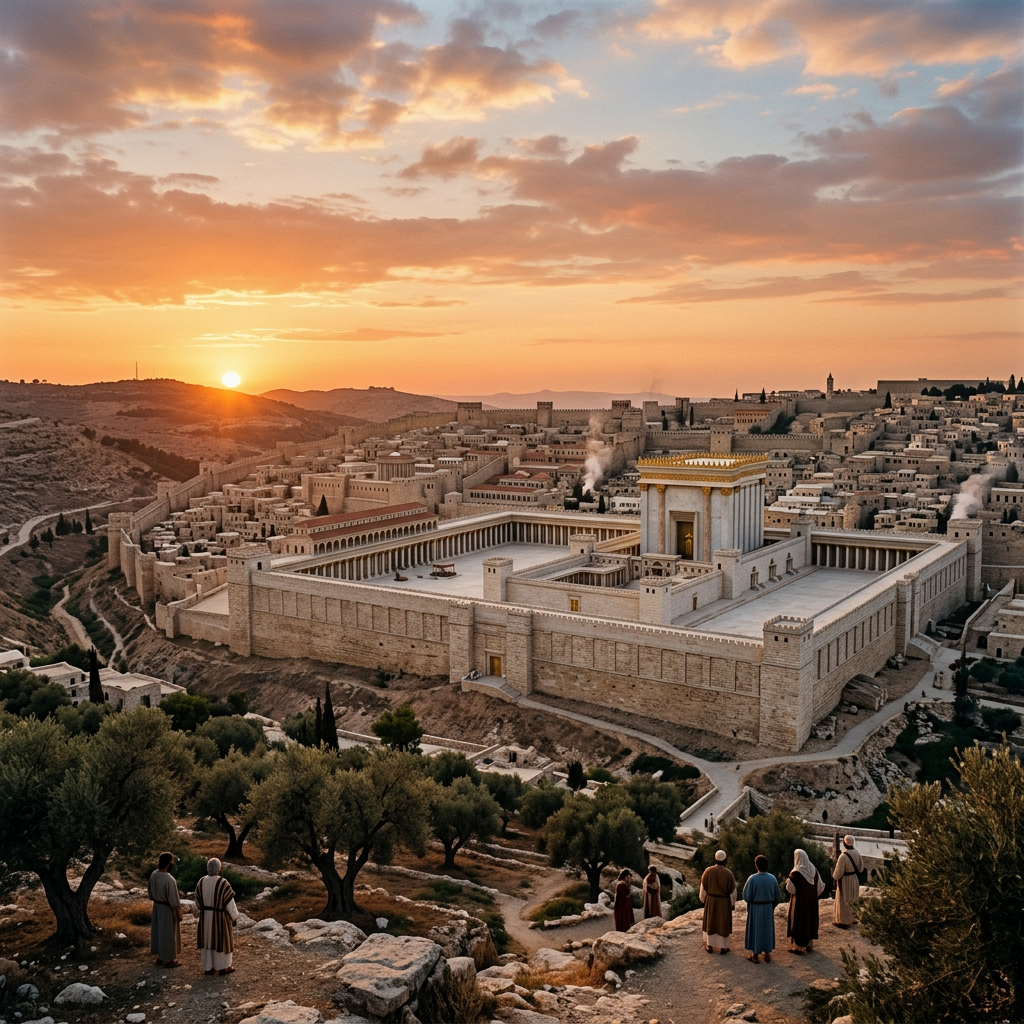
Jesus looked at one of the most magnificent structures in the ancient world and said it would be torn down so completely that not one stone would be left on top of another.
Forty years later it happened exactly as he said.
And the man who documented it was not a Christian.
He was a Jewish historian who had every reason to say nothing that supported Jesus.
The Scene
Jesus had just finished teaching in the Temple courts in Jerusalem.
As he was walking away, his disciples called his attention to the buildings around them.
They were not wrong to be impressed.
Herod’s Temple was one of the architectural wonders of the ancient world.
Built of gleaming white stone. Some of the foundation stones weighed hundreds of tons. The complex covered the area of several city blocks. Pilgrims traveled from across the known world to see it.
The disciples wanted Jesus to take it in.
His response stopped them cold.
“Do you see all these things?” he asked. “Truly I tell you, not one stone here will be left on another; every one will be thrown down.” Matthew 24:2 (NIV)
Not one stone on another.
Every one thrown down.
To anyone standing there that day, this would have sounded impossible. The Temple had stood for decades. Rome was at peace with Jerusalem. There was no army at the gates. There was no reason to believe any of this was coming.
Jesus said it anyway.
What Happened in 70 AD
Approximately forty years after Jesus spoke those words, the Roman general Titus marched on Jerusalem.
The Jewish revolt against Rome had been building for years. In 70 AD Titus surrounded the city with four Roman legions.
The siege lasted months.
Famine spread inside the walls. The historian Josephus, who was present and witnessed the destruction firsthand, documented the devastation in detail in his work The Wars of the Jews.
Josephus was not a follower of Jesus. He was a Jewish priest who had surrendered to Rome and served as Titus’s translator during the siege. He had no motivation to confirm Christian prophecy.
He simply recorded what he saw.
When the city finally fell, Titus gave orders to demolish the entire city and temple. The wall was leveled so completely to the ground that those who came afterward would not have believed the place had ever been inhabited.
A Roman officer named Terentius Rufus went further. He used a ploughshare to tear up the very foundations of the Temple, fulfilling the prophecy of Micah 3:12 that Zion would be plowed like a field.
Not one stone left on another.
That is not a figure of speech. That is a description of what the Romans did.
Why This Matters to a Skeptic
The standard skeptic argument against fulfilled prophecy is that the prediction was written after the event.
This argument does not hold for Matthew 24.
The gospel of Matthew is dated by most scholars to somewhere between 60 and 80 AD. The destruction of Jerusalem happened in 70 AD.
Even skeptical scholars who date Matthew to the late 60s or early 70s acknowledge the gospel was circulating before or around the time of the destruction.
But here is the stronger argument.
Jesus said not one stone would be left on another.
If someone was writing this after the fact to make Jesus look prophetic, they would have simply described the destruction and called it fulfillment.
Instead the gospels record a very specific, almost extreme claim. Not one stone on another. Every one thrown down.
That level of specificity is the language of someone predicting, not someone describing.
And Josephus confirmed it happened exactly that way.
The Temple Has Never Been Rebuilt
Here is what makes this prophecy even more remarkable today.
The Temple has still not been rebuilt.
The site where it stood, the Temple Mount in Jerusalem, is currently occupied by the Dome of the Rock, an Islamic shrine built in 691 AD.
For nearly two thousand years, the Jewish people have not been able to rebuild what Rome destroyed in 70 AD.
Jesus said the stones would be thrown down. He did not say when they would be rebuilt.
They have not been.
What He Said That Is Still Ahead
Jesus did not stop at predicting the destruction of the Temple.
In the same conversation on the Mount of Olives, he went on to describe signs of what is still to come. Wars. Famines. Earthquakes. The gospel reaching every nation. And his own return.
The disciples asked him two questions that day. When would the Temple be destroyed? And what would be the sign of his coming and the end of the age?
He answered both.
The first answer has been documented by a non-Christian historian and confirmed by archaeology.
The second answer is still unfolding.
A man who was right about the first in such specific and verifiable detail is worth taking seriously about the second.
He also said he was going to prepare a place for us. He also prayed the night before he died that we would be with him where he is.
The stones of the Temple were thrown down exactly as he said.
The promise he made to come back is still standing.

If you’re wondering whether Jesus really was who He claimed to be, that’s the question this entire website explores.
Start at the beginning with, Did Jesus Lie?
More Questions About Jesus
Did Jesus tell us the signs of the end times?
Yes. After predicting the destruction of the Temple, Jesus answered His disciples’ questions about the end of the age by describing wars, earthquakes, false christs, persecution, and other signs that would precede His return. Learn more in Did Jesus Tell Us the Signs of the End Times?
Did Jesus predict false christs would come?
Yes. In the same conversation where He foretold the Temple’s destruction, Jesus warned that many false messiahs would arise and deceive people. History has confirmed His warning as numerous individuals have claimed to be the Messiah over the centuries. Read more in Did Jesus Predict False Christs Would Come?
Did Jesus promise He is coming back?
Yes. Jesus not only predicted the destruction of Jerusalem, but also promised that He would return in glory. Because His prophecy about the Temple was fulfilled exactly as He said, Christians have confidence that His promise to return will also be fulfilled. Learn more in Did Jesus Promise He Is Coming Back?
Did Jesus fulfill every Old Testament prophecy about the Messiah?
Jesus fulfilled every prophecy related to His first coming, providing strong evidence that He is the promised Messiah. His accurate prediction of the Temple’s destruction further demonstrates that His words can be trusted. Read more in Did Jesus Fulfill Every Old Testament Prophecy About the Messiah?
Why is the destruction of the Temple important?
The destruction of Jerusalem’s Temple in AD 70 is one of the clearest examples of Jesus accurately predicting a major historical event decades before it happened. It provides historical evidence supporting His credibility.
Who was Josephus, and why is his account significant?
Josephus was a first-century Jewish historian who witnessed the Roman destruction of Jerusalem. Because he was not a follower of Jesus, his account provides independent historical confirmation of the Temple’s destruction.
Why does this website ask, “Did Jesus Lie?”
Every article on this website examines a different claim, prophecy, promise, or prediction made by Jesus. Together they answer one central question: Was Jesus telling the truth? If you’re beginning your journey, start with Did Jesus Lie? to see how all of the evidence fits together.
Leave a Reply